Creativity: Generally
Visual Creativity

On the Mind,
Emotions,
Human Nature
This
page>
On Creativity, On Administration; Some Personal History
On Love; On
Learning ; Miscellaneous
Short Quotes
On Modernity
and Related Matters
On Israel, Jewish/Spiritual Matters and
Anti-Semitism
Other Favorite
Quotations:
Poetry
Song Lyrics

Listen, listen; this sound brings me back to my true self.
Thich Nhat Hanh
Music is the mirror of our deepest longing.  When you hear violence in someone else's music,
you are hearing that musician's best effort to work out the longing to belong, even if it may not be
the effort you would exert, or any belonging you might identify with.  Underneath the harshness is
the struggle for wholeness....
The hardest thing is to realize that the terrible darkness in music is your own darkness exposed....
W. A. Mathieu, Consonance and Dissonance,
from The Musical Life:
Reflections on What it is and How to Live It
The composer
Stravinsky had written a new piece with a difficult violin passage.
After it had been in rehearsal for several weeks, the solo
violinist came to Stravinsky
and said he was sorry, he had tried his best, the passage was too difficult,
no
violinist could play it.
Stravinsky said, " I understand that.
What I am
after is the sound of someone trying to play it."
Thomas Powers
The
real art of conducting consists in transitions.
Gustav Mahler
In my music, I'm trying to play the truth of what I am.
The reason it's difficult is because I'm changing all the time."
Charles Mingus
Music seems to have an almost willful, evasive quality, defying
simple explanation,
so that the more we find out, the more there is to know, leaving its power and
mystery intact,
however much we may dig and delve. There may be no simple answer [to this this
paradox],
or end in sight, but the ride is nonetheless a thrilling one....
Sting ,
commenting on
Daniel J. Levitin,
The World in Six Songs (2008)
There is, in fact, no such thing as a “note” in music.  A note is an abstract symbol representing a tone,
which is an actual sound.   You can play thousands of so-called B’s or C’s and they will all be different.
 Nothing can be standardized.  Each vibratory event is unique.
Stephen Nachmanovitch, in Free Play (1990)
If I were not a physicist, I
would probably be a musician. I often think in music.
I live my daydreams in music. I see my life in terms of music. ... I get
most joy in life out of music.
Albert Einstein.
You gotta be in the sun to feel the sun - and that's the way it is with music.
Sidney Bechet

Talking about music is like
dancing about architecture.
Elvis Costello
Keith Jarrett,
Liner Notes to Spirits 1 & 2,
(ECM 1333/34, 1986):
There is a fine line between using technique and making music.
We must be open to the spaces (silence) in order to fill them just right.
We must see the spaces, inhabit them, live them.
Then the next note, the next move, becomes apparent because it is needed.
Until it is apparent, nothing should be played.
Until it is known, nothing should be anticipated.
Until the whole appears, nothing should be criticized.
Until you are participating in this, you cannot hear.
Until you hear, you cannot play.
Until you listen, you cannot make music.
Music is a part of life. It is not a separate, controlled event
where a musician presents something to a passive audience.
It is in the blood. A musician should be able to reveal this.
Music should not remind us of the control we seem to have over our lives.
It should remind us of the necessity of surrender,
the capacity in man for understanding the reason for this surrender,
the conditions that are necessary for it, the Being necessary for it
|
||
|
|
||
I cannot say what I think is right about music;
I only know the "rightness" of it.
I know it when I hear it.
There is a release, a flowing out, a fullness to it
that is not the same as richness or musicality.
I can talk about it in this way because
I do not feel that I ”created‘ this music
as much as I allowed it to ”emerge.‘
It is this emergence that is inexplicable
and incapable of being made solid,
and I feel (or felt) as though
not only do you never step in the same river twice,
but you are never the same when stepping in the river.
|

Do not fear mistakes.  There are none.
Miles Davis
I'll play it first and tell you what it is later
Miles Davis
 |
Try to imagine the very first musician. He was not playing for an audience, |
|
Every year the number of musicians who remember why they play music in the first place grows smaller…” It is the individual voice, present to itself, that needs to be heard. |
||
 |
|
|
|
||
|
|
||
A shaman typically needs three things: power songs to summon his spirit allies,
spirit allies to guide him to the world tree, and a drum to ride there on.  ...
[In possession trance,] the spirits ride the drumbeat down into the body of the trance dancer.
Scholars connect the West African possession cultures with
the ancient Neolithic mother goddess culture that nine thousand years ago stretched
from eastern Europe into what is now the Sahara desert.
When the slave trade began in the seventeenth century, this technique of possession trance
was carried to the new world....  In America, where the drums were prohibited for many generations,
this legacy of possession trance dance rhythm was shorn of its spiritual dimension becoming instead
jazz, blues, rhythm and blues and rock and roll.
Micky Hart (of the Grateful Dead), Planet Drum, A Celebration of Percussion and Rhythm.
|
||
|
|
||
|
|
These comments by Micky Hart excited me because I have heard and read of great beings
who have said many times that all search for sense pleasures is really the search for God. Even the conqueror in war -- what is he looking for? No matter how much of the world he rules in his life, he will have to surrender it when he dies. So what is he really after? Although he doesn't realize it, he is seeking oneness with the self in all things. When a musician superficially craves security in the level of his playing, what is he really after? It is said that one drop of ecstasy tasted from the self, the God inside us, renders all other pursuits insignificant. At that point, the seeker has found everything he has sought. Every song is either praise or an entreatment for more connection with the beloved. |
|
|
|
As enslaved peoples are separated from their religion, the lyrics of the song change.
The cry is for sense pleasures: more sex, money, alcohol. ...Desire for "my God" is supplanted by
But the cry is still there, even if man no longer knows for what. It is the yearning for unity, for oneness as experienced in the mother's womb, attuned to the rhythm of her heartbeat. The muffled song can still be heard from the God within "seeking to behold himself" and man's yearning to behold himself," and man's yearning to be one with him. Later the blues, drained of all meaning, decays into a twelve bar crossword puzzle to be "re-harmonized" in theory class. Finally, jazz visionaries revive it as an Indian Tala and ascend on its numeric highway. Kenny Werner, Effortless Mastery: Liberating the Master Musician Within
|
|
|
|
||
One good thing
about music,
when it hits you,
you feel no pain.
Bob Marley
|
|
|
|
|
||
|
|
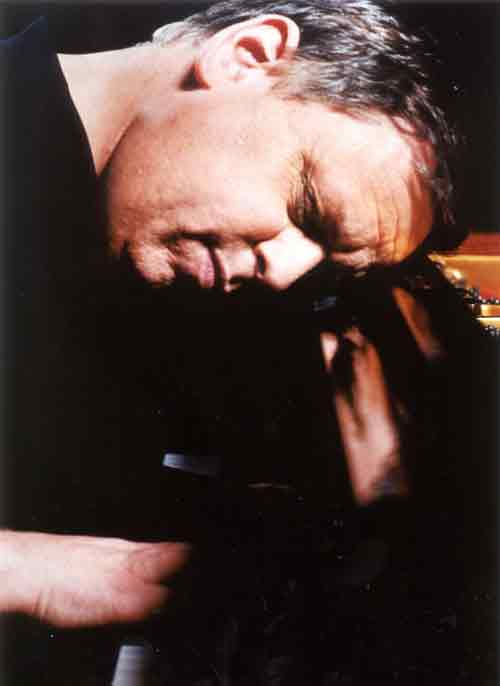
"Ayers tucks the violin under his chin,
blocks out the roar of traffic and leaves the known world.
He scratches around a bit, chasing after ideas
that aren't quite coming together, but then, as always,
he finds a passage that works like a drug
and the music pushes him free of all distraction.
Eyes closed, head tilted to the heavens, he's gone."
|
|
Make your own kind of music.
Mama Cass
|
||
|
||||
My creed for art in general is that it should enrich the soul;
it should teach spirituality by showing a person a portion of himself
that he would not discover otherwise . . .
a part of yourself you never knew existed.
Bill Evans
|
||||
|
||||
|
|
||||
Music is the art of the prophets
and the gift of God.
Martin Luther
Music fills the infinite between two souls.
Rabindranath Tagore
Music in the soul
can be heard by the universe.
Lao Tzu
|
||||
Music is the movement of sound to reach the soul for the education of its virtue.
Music is a moral law. It gives soul to the universe, wings to the mind,
flight to the imagination, and charm and gaiety to life and to everything.
Plato
|
||||
Music never dies in terrible times.  To the contrary, it flourishes.  At those times,
the essence of what music can provide really comes through.  The music that gives strength
to deal with the atrocities of the day, a song that can articulate our pain, the dance that
plays out our longing, the poetry that restores for us a moment of tranquility or incites us to riot --
that's what becomes important.
Ultimately, musicians of the world must come to realize the potential of their calling.  Like the shamans,
we may serve as healers, metaphysicians, inciters, exciters, spiritual guides and sources of inspiration.
If the ,musician is illumined from within, he becomes the lamp that lights other lamps.  Then he is serving
as a vehicle for the healing sound of the ocean of sound to wash over our planet and its people, healing
what ails us.  Such music is really important.
Kenny Werner, Effortless Mastery: Liberating the Master Musician Within
|
||||
I am in need of music that would flow
Over my fretful, feeling fingertips,
Over my better-tainted, trembling lips,
With melody, deep, clear, and liquid-slow.
Oh, for the healing swaying, old and low,
Of some song sung to rest the tired dead ,
A song to fall like water on my head,
And over quivering limbs, dream flushed to glow!
Elizabeth Bishop from Sonnet |
||||